CAIP Mapping

CAIP Mapping

Thursday, July 30, 2009

Fallingwater(s) in Beijing and Shanghai

Frank Wright's Fallingwater, Pennsylvania, USA


Fallingwater in Shanghai


Fallingwater in Beijing


[via abbs]

CAIP lectured @ Chinese Designers' Region


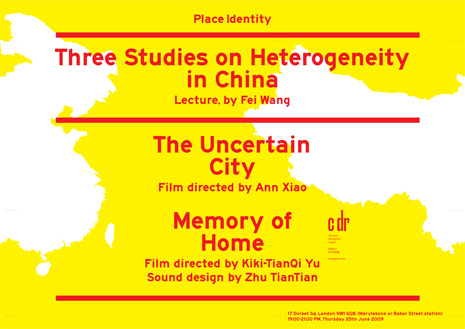
CAIP co-founder Fei Wang gave a lecture, "Three Heterogeneity Studies of China, between the 18th Century and Contemporary" at Chinese Designers' Region (CDR), London, in June 25th, 2009.

Thanks for William Chen's invitation and nice discussions!

[This is old news. Due to China's Great Fire Wall, blogspot is blocked as always. Sorry for the late update.]

囧 Building in Chongqin

Someone found out a residential building in Chonging like a face, and very popular Chinese character (jiǒng).

from wikipedia:

"Jiong (Chinese: 囧; variant: 冏; Hanyu Pinyin: jiong3; British Cantonese: Gwing) is a Chinese character meaning a "patterned window" or "as bright as the light peering from outside the window". The character is now rarely used in this sense.

Internet emoticon usage

The character for "Jiong" is nowadays more widely used on the Internet as an ideographic emoticon representing a range of moods, as it resembles a person's face. It is commonly used to express ideas or feelings such as annoyance, shock, embarrassment, awkwardness, scorn or the internet meme "DO NOT WANT".

The use of Jiong as an emoticon can be traced to 2005 or earlier; it was referenced on 20 January 2005 in a Chinese-language article on orz.[1] The character is sometimes used in conjunction with orz, OTZ or its other variants to form "囧rz", representing a person on their hands and knees (Jiong forming the face, while r and z represent arms and legs respectively) and symbolising despair or failure."

[via tianya]

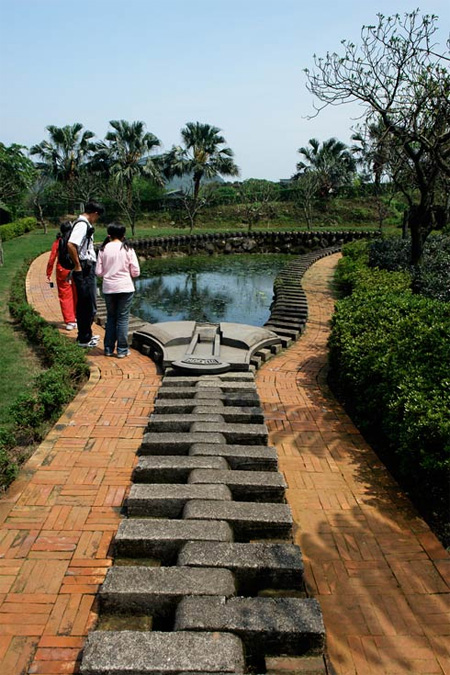
Zipper Pond in Taiwan

Ju Chun, a renowned Taiwanese sculptor, created this breathtaking Zipper Lotus Pond for the Juming Museum, located just outside Taipei, Taiwan.
[via toxel]

Thursday, May 7, 2009

Fake Beida (Beijing University)


Bei Da Xue Yuan High school, Dongguan, Guangdong Province

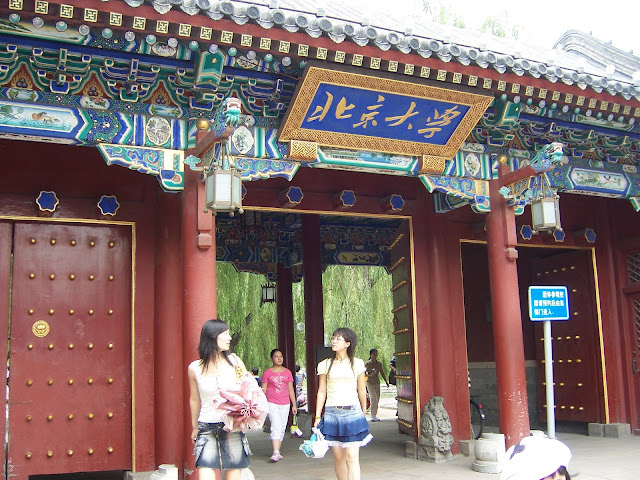
This is fake Beijing University gate in Dongguan, Guangdong (Canton) Province, which was is a local high school and called the coolest (niu) school gate by bloggers. This school advertises itself in relation with Beijing University and graduates from this school can go to Beijing University directly with exemption of college entry exams. The title of the school is “Bei Da Xue Yuan”, in which there are 3 same characters from Beijing University famous gate, “Bei Jing Da Xue”. Even the calligraphy is totally copied from the Beijing Univ.


Beijing University, Beijing


[via 163 and picasa]

Friday, March 27, 2009

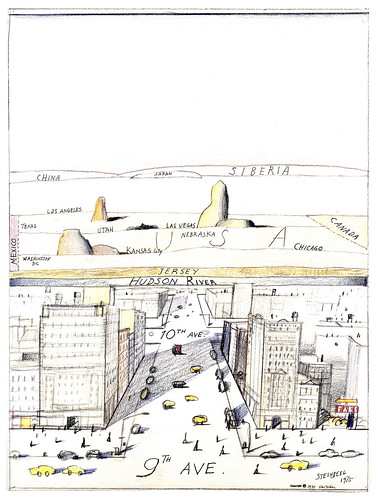
How China Sees the World

This is the cover from The Economist, titled "How China Sees the World," which has similar connotation and technique of Saul Steinberg's early work "How New Yorker Sees the World."
Friday, February 13, 2009

Wu Liang Ye Headquarter


This is the headquarter of one the most famous Jiu, Chinese alcoholic beverages, Wu Liang Ye, in Yibin, Sichuan Province. All buildings there are very iconic (as bottle, package, company icon, etc), including the gate, factory, administrative buildings, etc.
[via abbs]

Macau Pavilion 2010


This is the new released Macao Pavilion for 2010 Shanghai World EXPO, titled “Moon Rabbit Lantern”, by Carlos Marreiros. The iconic building is to represent the Rabbit year (1999) when Macao was returned to China.


Monday, February 9, 2009

OCT East resort, Shenzhen


Another Swiss Interlaken (I have no idea where it is until now) simulacra town in Shenzhen, where there are many theme parks already. Actually, it is the combination of the Western and Eastern. It is very popular for Bourgeois Chinese, who often spend the weekend there.

From the official website: “OCT East resort, a 3.5-billion-yuan (US$0.5 billion) investment supported by OCT group, is located at DaMeiSha, Shenzhen. Occupying about 9 square kilometers, OCT East, the national ecological resort featuring tourism culture, aims at providing visitors with an opportunity to escape from the bustle of city life and return to the nature.
Elaborately designed along the mountain and the sea, OCT East resort has three major theme parks: Knight Valley, Tea Stream Valley and Wind Valley. It has many culture travel functions like ecological tourism, vacation, outdoor sports etc., indicating the harmony relationship between human and the nature.

Phase I of the resort opened on Jul. 28th 2007, offering a vast array of attractions to the public. Tea Stream Valley, a combination of western and eastern cultures, has been constructed based on many fundamental elements such as tea, Buddhism, follower and bamboo etc. Wind Valley features Olympic and golf sports, the Interlaken OCT Hotel, The Interlaken Spa, and the Tea Show. The second phase of the project, Knight Valley, will open in 2008. This park will distinguish itself by forests, rivers and outer space, Red Wine Town and the Statue of Guanyin Sitting in a Lotus Throne.”

[Interlaken is a municipality in the district of Interlaken in the canton of Bern in Switzerland, a well-known tourist destination in the Bernese Oberland.] from Wiki

[via OCT East, many thanks for Jianjia Zhou]

Lecture @ Cincinnati Art Museum

On January 7, 2009, CAIP co-founder Fei Wang gave the closing lecture for the Cincinnati Art Museum's current exhibition, "China Design Now." His presentation was titled "Three Heterogeneity Studies of China, between the 18th Century and Contemporary."

"China Design Now," organized by the Victoria and Albert Museum, captures an extraordinary moment as China opens up to global influences and responds to the hopes and dreams of its new urban middle class. This is the first exhibition in the United Kingdom and United States to explore the recent explosion of contemporary design in China and the first to attempt to understand the impact of rapid economic development on architecture and design in the country's major cities. From significant architectural projects, including the 2008 Olympic national stadium, to the latest in fashion and graphics the exhibition investigates this dynamic phase.

(Many thanks for Aaron Betsky's generous invitation.)

Thursday, October 30, 2008

fake Water Cube in Chongqing


This is a new Water Cube at Han Yu Rd 汉渝路 in Chongqing. It looks like a bar. Apparently it got inspiration from Water Cube in Beijing.
Here is video.
http://v.youku.com/v_show/id_XNDk3NTMxNTY=.html (just in case it doesn't show up here.)

[via
shanghaiist and picasa]

Monday, October 6, 2008

Herzog and de Meuron 's woosaaaaah

On a cooking competetion, one of the contestants shows her masterpiece named BIRD NEST which made of eggs tomatoes and noodles.
[fa32d8e86f613b5f1efc0dde5e01026f.jpg]

On a hairstyle show, the hairstyle designer shows his piece proudly.

[b9a7d07811bc41b9d4366129cb210da4.jpg]

Kids are asked to make paper models in their class as homework

[cf0331531c50acd9e3af34400ec95b91.jpg]

a basket made like the BIRD NEST
[e6a7e7a3150cdc317d93d79f616e6ca8.jpg]

BIRD NEST Teapot with very high price.
[e010a384489d1d2ba68984d7050d8588.jpg]

BIRD NEST lights.
[ee47722b0a181f21ed62ec271269567d.jpg]

city sculpture in Nanjing.
[0ae804cddb170cafb014065dedbcd0ca.jpg]

City sculture in Tiananmen Square
[0fd16608e5c0ac3169632b63e2f56d15.jpg]

Another city sculpture
[6ce9b44174c64f937c34d5ac292365a1.jpg]

BIRD NEST Luxory made of silver which is now worth at least 5 million RMB
[25be20d23b31ca061ec30fbc700023a6.jpg]

A man who loves sports wearing a Olympic hat made by himself on a swimming gathering.
[668c8c3a46070a82e51cb76d95c1f50d.jpg]


Well, Rem Koolhaas has done a lot to transform his CCTV building into cultural recreation by making all kinds of daily products. However, He would never imagine that Herzog and de Meuron's so-called BIRD NEST has been transformed totally into simulacra by the whole Chinese society without any effort by these two constructing approach architects.

[via Netease]

Tuesday, September 16, 2008

a colossal Bavarian castle in Dalian


Dalian Seashell Museum, also known as Dalian Castle Museum, is the biggest one of this kind in Asia. The 1st floor is the museum and the above is hotel. It was built in 2000 and put into use in 2003.
According to the report in 2006:
"The castle will be sold for 260 million RMB ($39 million USD). The original squarefootage was planned to 31500 sqm (339063 sqf), including public facilities in the front, 3 residential towers with 11 stories, 13 stories and 15 stories respectively. There was supporsed to be the sailing museum. Although since July 17, 2003 the Seashell Museum was open, most areas have been empty for a quite while. ..."
[via here, here, here, here and here]

Monday, September 15, 2008

South China Mall, the biggest mall in the wolrd


South China Mall, Dongguan, Guangdong Province, is so-called the biggest mall in the wolrd. The total land area is 430,000 sqm (4,628,500 sqf) and construction area is 890,000 sqm, with 8000 parking spots. The investment is over 2.5 billion RMB (0.4 billion USD). The construction launched in October 2002.
According to many resources:
"The South China Mall is the combination of tourism, cultural events, shopping, entertainment, sports, restaurants and hotel. There are 7 special theme districts: sunny and passionate Southern California and San Francisco, Fresh Amsterdam, High-class and romantic Parisian the Avenue des Champs-Élysées, world-famous canal town Venice, sensitive and beautiful Caribbean Sea, and adventurous rain forest."

It even has wiki here.
[images via here, here, here and here]

Tuesday, September 9, 2008

hybrid KFC


This is a new building of Min Nan (Southern Fujian Province) style building in a new high-rise residential district. And it is KFC!


[via tianya]

Thanks Adan

Tuesday, August 26, 2008

Huainan Olympic Park


Although the Beijing Olympics is over, but the passion of the Olympic spirit is still on. Here is the new released project of Huainan Olympic Park, Huainan, Anhui Province. Can you tell all these balls?
Remember the Villa Piano and Violin from last year? It's the same city.

Thanks Koala Shiyun from OMA!

Thursday, August 7, 2008

bird's nest in bamboo

As the Olympics approaches, I always found more and more interesting things by regular Chinese. Here is another story. Some farmers in Shuangxi, Hangzhou, Zhejiang Province, made a bamboo Bird's Nest of the scale 1:20, which took them half a month and spent almost a thousand pieces of Mao zhu, the local bamboo. [via pclady]


Also, a friend of mine recommends a bar at Fuxing Park, downtown Shanghai, which has a kind of Water Cube façade, esp. at night.

[Courtesy of CAIP]

Friday, July 25, 2008

Bird's Nest on Sale

Not just cellphone, Bird's Nest ashtray is also on sale, in silver and gold.
Here you go.

Wednesday, July 23, 2008

Cellphone as Building


Watercube Cellphone


Bird's Nest Cellphone


Just in case you don't know what I'm talking about. Here are the 2 references of the 2 stadiums of Beijing Olympics.

[images via 163 & schneiderism]

Monday, July 21, 2008

Buddha Buildings in China

Lu Shan, Henan Province, 153M (built in 2002-2005)


Nan Shan, Hainan Province, 108M (2005)

Wuxi, Jiangsu Province, 88M (1997)

Foshan, Guangdong Province, 61.9M

Emei Shan, Sichuan Province, 48M (2006)


Panyu, Guangdong Province, 40.88M (1994)

Yantai, Shandong Province, 38.66M (2004)

Putuo Shan, Zhejiang Province, 33M (1997)

Hong Kong, 26.4M (1993)

Weihai, Shandong Province

Jiuhua Shan, Anhui, 99M (to be built)

Xinzhu, Taiwan, 72M (2006)

Friday, July 11, 2008

Le Corbusier in Guangzhou


(please click and read the English part, if you are an architect.)

When I walked around the new district of Guangzhou, Guangdong Province, I found a series of interesting ad for a new residential development. I don’t really care about the concept at all, but just the text. If you are an architect, and you can read a little bit English, you will be surprised to see this. “If there were only one form, there would not be Le Debuxixie.” Actually, the Chinese counterpart is “Le Corbusier”. This happens everywhere in China when the Chinese try to imitate something they don’t really understand but they thought they do. But as Baudrillard says, “The whole system becomes weightless, it is no longer anything but a gigantic simulacrum – not unreal, but a simulacrum, never again exchanging for what is real, but exchanging in itself, in an uninterrupted circuit without reference or circumference.”

Thursday, July 10, 2008

Cell Phone Building in Tianjin


This is a cell-phone-like building in Tianjin. I have no idea what it is for. It's similar with the Key Board Building in Shanghai.
[via abbs]

Sunday, June 22, 2008

"Ronchamp" disappeared

Ronchamp, Zhengzhou, 2004
BBQ On the original site, 2008

There was a Ronchamp in Zhengzhou, Henan Province, my hometown, in the West Economy Development District. I have post it a while ago, here. On the same street, there are different simulacra from many other cultures, including Greek Temple (posted here), St Marco in Venice, Dutch style, American Style, etc. When I went back this year, I found out the fake Ronchamp has disappeared and turned into a BBQ restaurant, which is the only one on the street. However, Corbusier's sculpture is kept inside the wall. Many other buildings have transformed into other programs, such as Gas company, Kindergarten, University, Fine Arts school, seemingly private house, besides original programs of entertainment centers (sauna, Kara OK, hotel, etc.). But there are still many buildings empty and abandoned.
[CAIP owes the copyright of all images]

Friday, June 20, 2008

SIAS International University, Zhengzhou

The Administrative Building's back facade

The Administrative Building's front facade

European Commercial Street

Another view

This is a new university in Zhengzhou. The administrative building has 2 faces, like the god Janus, but with the East and West. There is also another European Commercial Street.

[iamges via http://sias.zzdxs.net/xinsheng/2008/0527/article_39.html]

Saturday, April 19, 2008

Splendid China锦绣中华, Shenzhen


Due to what is happening in China and of the Chinese, I came across this image from Cute Hisotry. Olympics turns to Olympolitics, and now Patriotertainment. Where is the splendid? There is also another counterpart of Splendid China in the same city Shenzhen, the Window of the World.

"Splendid China (Chinese: 锦绣中华, Pinyin: Jinxiu Zhonghua) is a comprehensive miniature park reflecting the history, culture, art, ancient architecture, and customs and habits of various nationalities in China. It is one of the world's largest scenery parks in the amount of scenarios reproduced. The park is developed and managed by the major travel and tourist corporation, China Travel Services.

Over 100 major tourist attractions have been miniaturized and laid out according to the map of China. Most attractions have been reduced on a scale of 1:15. It is divided into Scenic Spot Area and Comprehensive Service Area. The entire park covers 30 hectares.
There are cars and trains to transport visitors around the park, making it possible to visit the Great Wall of China, Forbidden City, Temple of heaven, Three Gorges Dam, Potala Palace and the Terracotta Army in one day.
The park also hosts several shows depicting various events in Chinese History (e.g. a horse riding show depicting a battle led by Genghis Khan), Chinese Cultural Show, etc. Some of the shows are only performed on weekends.

A Splendid China was also built in Orlando, Florida in 1993. It featured similar models of The Great Wall of China, Terra Cotta Warriors, The Forbidden City and Potala Palace. The park closed in 2003."

--wikipedia

[image via cute history]

Sunday, April 6, 2008

Bird's Nest and mini Bird's Nests


[images via 163 & xinhuanet]
The lights on the plaza around the Bird's Nest, Beijing Olympics Stadium, designed by Herzog & de Meuron, are like mini Nests. According to Xinhua Net, they are amazingly showing up and corresponding to the big Nest. But the material of all the small Nests is just showing the exterior appearance of the imitation of the big one, and the section of the small lamps are with the same proportion as the big one. I am interested in who is the architect or landscape architect of all these mini nestles, and I don't think they are designed by H&deM.

It reminds me Galileo's discussion in his final treatise Dialogues Concerning Two New Sciences (Discorsi e dimostrazioni matematiche, intorno a due nuove scienze, 1638).


from Galileo Galilei, Dialogues Concerning Two New Sciences (The Discourses and Mathematical Demonstrations Relating to Two New Sciences, Discorsi e dimostrazioni matematiche, intorno à due nuove scienze, 1638)

Wednesday, February 27, 2008

Foreigner Street洋人街 @ Chongqing


Chinatown gate at Foreigner Street (London Style)


I was quite speechless seeing this Foreigner Street. Strictly speaking, it is a theme park, just a pedestrian street by the river, but fairy-tale like. It has everything, and everything is with each other: St Antonio River with 32 world-famous bridges, Liberty Statue on Titanic, even a Chinatown gate (London style), Golden Reception Hall, Dutch style, Chinese style, Sphinx, and the world-biggest public bathroom with 1000 capacity, etc. This is the extreme of simulacra in China, quite not well educated intuitively application. The collage/montage is very colorful and vivid for local people and some tourism.
Some slogans are quite remarkable. “God bless Foreigner Street.” “Similar Harmonious Society 仿和谐社会.” “Respect other people’s property.” “If you are Titanic, the iceberg will sink.” “Lenin says, no rest, no work.” Etc. everything could happen here.
I cannot wait to visit there as well.

More images are here and here and here and here.

Island of the Blest三仙山 @ Penglai蓬莱


A new fake antiquity will be open to public in Penglai, Shandong Province, in May 2008. It is the famous legend of Island of the Blest 三仙山 in the story of Eight Immortals 八仙, who lived in Penglai Mountain Island. This new legendary island is a tourism park, run by “Eight Immortals Tourism Co., Ltd Penglai Shangdong”. It is also called “the Heaven in the Sublunar”.

It looks really fairy from photos without the neighboring residential area. I’m looking forward to visit it soon.
More images are here.

[images via xinhuanet & penglai.gov]

Thursday, January 31, 2008

Along the River During the Qingming Festival

The are physical versions of the famous Chinese painting "Along the River During the Qingming Festival" in Kaifeng (Henan Province) and Hengdian World Studio (Zhejiang Province) now. The original long scroll painting was painted by Zhang Zeduan (early 12th Century), Song Dynasty, depicting the life and market of the ancient city Kaifeng, then there were many other versions in Ming and Qing Dynasties.

Zhang Zeduan, "Along the River During the Qingming Festival", early 12th Century


The park of "Along the River During the Qingming Festival", Kaifeng, Henan Province


"Along the River During the Qingming Festival", Hengdian World Studio, Zhejiang Province


It seems there are competitions between Kaifeng and Hengdian, like many versions of the scroll paintings. The one in Kaifeng launched in 1998, 2nd phase in 2005, and 3rd phase coming soon; the one in Hengdian was in use since 1998 as well. The one in Kaifeng has about 600 acres in land, 180 acres of water area, 50 ancient boats, 400 rooms, and constructions area of 30,000 sqm (300,000 sqf), with 300million Chinese Yuan ($40million) investment for 1st 2 phases; while the one in Hengdian is about 800 ares in land and 100,000 sqm (1 million sqf). They are so-called built in “1:1” scale, but where is it from, because the buildings of Song Dynasty don’t almost exist anymore, and few drawings are left? Tourists are really willing to spend much money on these fake antiquities, and every city needs one, their own version.

Sunday, January 20, 2008

No. 1 Village in the World

"No. 1 Village in the World"

Actually, the red text in Chinese is "the Capitol of the United States of America".
Tian'anmen

The red text is "Roman Church".
"The Great Wall"
This is so-called "No. 1 Village in the World", Huaxi Village, Jiangsu Province, which is a really reach village in farming. The urbanscape and architecture are collages of Chinese and Western styles and a typical example of simulacra. There are Tian'anmen Square (which I have shown before, here), the Great Wall, Capitol Hill, Chinese Towers, etc. This is the way how farmers show the richness.
[via jsdj]

Friday, January 18, 2008

Happy Valley


I just found out that there are a couple of theme parks called Happy Valley in Beijing and Shenzhen, and construction in Shanghai and Chengdu. The one in Beijing was open to public in 2006, which is about 1 million sqm in area in Southeast Beijing. It was called "the frontier of cultural industry of Beijing, the classical of modern Chinese tourism, and an important symbol of experiential tourism in Beijing." The Lost Maya, Atlantis, and Aegean Harbor are made as "real and ancient" as they could. In most cases, they are out of scale and the vegetation is really weird, and out of the "original" context.

Sunday, December 23, 2007

Trompe l'oeil in Shanghai Changes its face for EXPO2010


Previously, CAIP introduce the tempo l'oeil in Shanghai. The facade of the abandoned building is covered by printed windows, which can be considered as a parody of architecture. In fact, obviously, no one cares about architecture and its representation. The only theme of the abandoned building is supposed to be propoganda of politics since it is just next to the secret political conference place - Ma Le villa on Shanxi Rd of Shanghai and it is a good eye-catched place both from ground or from the inner ring highway. As expected, the facade is now changed into 海宝(Haibao, literally means baby of the sea), the mascot of EXPO2010 in only one night.

Saturday, December 22, 2007

China Pavilion for EXPO2010

He Jingtang, China Pavilion, Shanghai EXPO 2010
China Pavilion of Shanghai EXPO 2010 was released a while ago, titled "Crown of the East", designed by a senior Chinese architect He Jingtang, but now there are some interesting discussions about it on abbs, the world biggest architectural forum, of course in China.

The main issue is about: Where is the idea from? Is it representative of China after all? Many posters dig out the Japanese pavilion for EXPO '92, Sevilla, Spain, designed Tadao Ando. So, where are the both inspired from? Is His inspiration from Ando? Or is Ando's from Tang dynasty (618-907 A.D.) in China?

What we are interested in that no matter the architect He or the debaters on abbs, swamped in opticality again.

Todao Ando, Japanese pavilion for EXPO '92, Sevilla, Spain

[via abbs]

Comment by Yan known as ID Bendangwuren on ABBS

The competition of the pavilion undoubtly results in a typical Chinese way. As a citizen, maybe we could just think this as clownery and have fun.
For me, the most important focus is not about which real project did Mr He Jingtang copy from. Actually, he might willing to think about what is the tradition of China to be represented as the Government asked for. He also want to escape from the symbolic way of representing Chinese culture. By merging contemporary material and way of constructiong, he did this. (Although the name is Crown of the East, the original idea is to build a morden appearance of Dou Gong (corbel bracket). Ironically, the abstraction of traditional wood structure of China leads to an Japanese sytle inevitably. Wow, maybe Mr He himself didnt aware of that. Isn't true that Japanese people copied Chinese stuffs long long time ago, then made them into more abstract and practical way, which is now widely known as JANPANESE STYLE? Like karate is a typical Japanese kongfu which is copied from Chinese kongfu by simplifing all the looking-good techniques.

Till now, could we say that when we Chinese want to explain our tradition in modern western way (since we are also in modernizing by the western techonology and culture), we suddenly find that our neighbor Japan has already done that in very mature and successful way, plus, this has been known widely as Japanese tradition for the world. Thus, could we still boost this as our tradition by only symbolize the traditional Chinese style? What is the real tradition we had before, and what is we still have now? The issue becomes is the image of old China is the tradition or is the way of represetation means the traditional thinking of China, can we go out of just showing the image of tradition in western way? Neither the way nor the result is known as Chinese tradition. In this sense, do we still have tradition or could we find our new tradition?

It's kind of funny that recently, Chinese government control the public media to show hostility to Japan just the opposite to what they said 20 years ago. The primary goal is to divert domestic social complainment to outside of the country. Thousands of brainwashed Chinese young people expectedly become anti-Japanese generation. It is sacastic that the Chinese pavilion is now in clearly Japanese style. Hard to say what kind of public condemnation could be.

After all, it is still a very bad design. However, from another point of view. The project could be an very good irony. It not only shows the metaphorical meaning of Chinese society (Crown could mean we are still under the imperial power of the biggest communist partry), but also emerge social participation of Chinese sytle critisism, it might be a good chance to make "better city better life" in era of postcommunism.

Friday, December 7, 2007

Keyboard architecture in Shanghai


It is a keyboard like building in Shanghai. It looks like a professional technician school, in digital media technology.

address:上海市董恒甫职业技术学校/上海市徐汇区蒲汇塘路99号

[via Augapfel & dhfz]

Wednesday, November 28, 2007

The world's biggest ferris wheel in Beijing


"If tourism officials have their way, visitors to Beijing in 2009 will not only have to climb the Great Wall of China, but also the Great Wheel, says Ben Blanchard of Reuters.

At 208 metres tall, the Great Wheel will be the world's largest ferris wheel — higher and bigger than both the London Eye and the Singapore Flyer which opens in March next year.


Our eyes were drawn to these lines in the Reuters report:
The giant ferris wheel will have 48 air conditioned observation capsules, each of which can carry up to 40 passengers,...


Air-conditioned capsules? Without the a/c, we're not sure how many tourists would want to ride in the Wheel. The smog in Beijing literally takes your breath away.
...and on a good day even the Great Wall is expected to be visible in the mountains to Beijing's north.


On a bad day, we assume NOTHING will be visible." -- Shanghaiist

[via shanghaiist and yahoo]

Tuesday, November 27, 2007

5 sqm (50 sqft) luxury house


A white-collar worker, in Xiamen厦门, have worked for 8 years, earning much more than the average, however with his saving he only can afford 5 square-meter (50 square-foot) apartment. Thus, a young man, Lv Guohua吕国华, built his own 5 square-meter “luxury house豪宅”. After the construction was complete, this “the spokesman of Chinese housing slave中国房奴第一代言人” spent his first “golden week (week long Chinese National days)”.

“It is so pathetic to spend life in such 5 sqm”, some visitor says. But someone claims, “I feel so happy about him, because I’ve been working for so many year and I don’t even have such 5 sqm.”

It is a 2-story house of 3.2 m high. Mr. Lv could not stand straight at the 2nd floor because it’s only 1.3m high and Lv is 1.73m high. This little house situates in front of a big shopping mall and between 30-story residential towers in Canghai district of City Xiamen, Fujian Province.

[via south daily]

Thursday, October 25, 2007

Shanghai Gets Its Own Slice of English Countryside

Shanghai's city planners are carrying out an ambitious scheme to relieve population pressure: They are resettling 500,000 people in nine new towns in the suburbs. Each is built in a distinctive style, including an Italian town with canals based on Venice and a German town designed by Albert Speer, the son of Hitler's favorite architect.


Thames Town is one of these new settlements. It features cobbled streets, half-timbered Tudor houses, Edwardian townhouses, and a covered market with a clock tower and weather vane on top. Thames Town looks like an English country town. And that was the whole idea, to re-create Middle England in the Middle Kingdom.


Paul Rice, of the British company Atkins, was the lead architect for Thames Town. He says the developers of the community wanted a complete, functioning English town, with its own schools, shops, and residential and recreational areas.


Shanghai has a tradition of English, French and German architecture in the concession settlements of central Shanghai, Rice notes.


And the clients saw nothing strange about re-creating those types of settlements on the outskirts of Shanghai.


But when it comes down to it, in China, it's always about the bottom line.
Developer James Ho says the main consideration in building Thames Town was a commercial one.


"Beautiful buildings are always welcomed by customers. … If the building's style is different from others, it will have its own market. It will be easy to make money, to add profit," he says.
Thames Town even has its own church, complete with stained-glass windows and a towering spire. It's mainly being used now as a backdrop for wedding photographs.


Recently, a young couple, Yang Jinghui and Zi Haiying, posed for wedding photographs on the lawn in front of Thames Town church.

They say they love Thames Town, but although they have good jobs working for large Western companies, they don't think they'll ever be able to afford to live here.

One of the lucky few is a Mrs. Lu, who lives in a quarter-million-dollar villa.

"I like it because it's like a foreign country here," she says.

In fact, some have denounced the satellite town scheme as a form of self-colonization. Another criticism is that Thames Town is yet another example of China's copycat fever — a pale imitation at best.

In particular, two buildings have sparked controversy. There's a squarish, white, three-story building with a sign that reads "Rock Point Inn." It's next to a smaller, white building called "Cob Gate Fish Bar."

The problem is that these establishments do actually exist, and they've been copied wholesale from the British town of Lyme Regis. Their discovery in Thames Town sparked near hysteria in the British press, which carried interviews with the landlady of the pub and fish 'n' chips shop in colorfully titled pieces such as "Chinese Takeaway" and "How the Chinese Stole My Chippy."
Paul Rice from the architect Atkins denies any wrongdoing. He says the client saw the names of the buildings as "decorative," and that when tenants move into the buildings, they will change the names.

But even as Thames Town was declared open in a lavish ceremony, it seems far from achieving its original objective. With its empty streets and unrented shops, it's more like a ghost town. And with homes priced out of the market for many, Shanghai's plans for its satellite towns are placing gimmicky foreign settlements above the real needs of its own people.


---by Louisa Lim


Thames Town may look exactly like an English country village, but it's actually 25 miles southwest of Shanghai. It's one of nine new towns Shanghai planners hope will relieve population pressures in the city center.
The town's market square even has its own statue of Winston Churchill.

Yang Jinghui and Zi Haiying pose for wedding photographs in front of Thames Town's church.
Even Thames Town's security guards have special touches to their uniforms that seem designed to evoke English pageantry.
[via npr]

Wednesday, October 10, 2007

Elevator in Cliff, Zhangjiajie


"This controversial 326 metre high elevator takes you up the side of one of the many enormous cliffs in zhangjiajie, china - the lower 1/3 running from a cavern through the rock, the top 2/3 rising outside to the summit - and is the highest and heaviest outdoor elevator in the world. the elevator has an uncertain future due to the potential harm caused to the surrounding landscape."
--deputydog

[via deputydog]

Monday, October 8, 2007

Venice in Macau


The $2.4 billion Venetian Macao Resort Hotel is finally open for business on Macau's Cotai at end of August 2007. Las Vegas Sands claims the 10.5 million square foot (1 million square meters) Venetian — twice the size of the Las Vegas original — is the largest building in Asia.


Tuesday, September 25, 2007

Tianzi Hotel in Beijing


Tianzi (Son of the Heaven) Hotel was built around 2000 or 2001 in Yanjiao developing district (燕郊开发区) of Beijing, which won Guinness World Records of the world biggest image building in 2001. It is 41.6m high with the forms of three traditional Chinese gods (福禄寿, Happiess, Fortune and Longevity). This hotel is 10 stories high. The stardard room is smaller than normal ones, and ninth floor provides president suite. There is even an Peach-shape suite.

[via xinhuanet and many others]

Monday, September 24, 2007

21st centry Railway station


Isn't that funny this is a railway station? And it is more fun and ironically called 21st centry railway station. It could be considered as a new sample of "white-house-like" buildings in China. It is obvious that this kind of "architectural revolution" has spread into almost all kinds of urban facilities not only the governmental offices.
[via abbs]

Thursday, September 20, 2007

Villa Piano


"The "Piano House" is just finished recently in new district of Huainan City, Anhui Province. The building shapes of a pair of scaled piano and violin. The program is to exhibit the planning model of the new district."
--xinhua net

[via xinhuanet & abbs]

Up-side-down Villa Savoye

Villa Savoye at Helan Shan贺兰山, Ningxia Province
This project is done by Song Yongping, along with other 11 artists designing 12 houses at Helan Shan, which is called Helan Shanfang贺兰山房, organized by Lv Peng, a "uropian artisitic critic".
Le Corbusier, Villa Savoye , France (1929)

Monday, September 17, 2007

Tian'anmens in China

Xiayi, Henan Province 河南夏邑曹集乡
Linfen, Shanxi Province 山西临汾
Zhongxian, Chongqing City 重庆市忠县黄金镇 Huaxi Village, Jiangsu Province 江苏华西村


We know the Chinese likes to copy Western architecture, but they also copy their own buildings. Tian'anmen of Beijing is copied many times throughout China, which could happen the most among all Chinese buildings.

[source Xinhuanet]

Another "whitehouse-like" governmental building in Anhui Province


This governmental building is in Yingquan District of Fuyang, Anhui Province安徽阜阳颍泉区, which costs tens of million Chinese Yuan. It is "Western-style". The average annual income of local people is 2000 Yuan.

A very interesting thing is that the Chinese always misunderstands that Capitol as White House. If you check it around, you will never find such description that "Capitol-like" buildings, but always "Whitehouse-like", which are very different basically. However, few Chinese notices it at all.

Eiffel Tower in China


Not surprisingly, another famous building is copied in China. Sina reports that the "First" Eiffel Tower in Tianducheng Residential District in Lipingxingqiao Town of Hangzhou, Zhejiang Province will be completed the construction later October 2007. The scale is 1:3 as the Eiffel Tower in Paris, France. The tower is divided for 8 sections, each of which has eight-seeing platforms with the connection by tilted elevators. The tower is 108 meters high. "Then, the landmark of the French stylish small town, with the combination of tourism and residency, will erected in North Hangzhou."

[source Sina China]

Tuesday, September 4, 2007

New Landmark of Hangzhou


New conference center of Hangzhou is now finished (sphere one). the building like moon opposite to it is the new opera house in silver. These two governmental public buildings defines the new landmark of Hangzhou city by the Qiantang river bank. They are just a typical type of defining Chinese public space in a place where no one could ever think of hanging out there.

[source: abbs]

Monday, August 27, 2007

Simulacra, Hengdian

Forbidden City, Beijing
Forbidden City, Hengdian World Studio, Zhejiang Province (the mountains are kind of a giveaway)
Another view of the Forbidden City, Beijing
and the ersatz Forbidden City, Hengdian World Studio, Zhejiang Province


"NPR reports:
In just 10 years, Hengdian [World Studio] has transformed itself from a poverty-stricken farming village to a collection of replica palaces, temples and historical streets, open to film crews, often for free."

"These aren't just replicas, they're full-size reproductions. It's an amazing and terrifying verisimilitude. Even more so because China's very real history is being projected onto the structures themselves -- really just facades and empty shells -- outside the context of the in-film world.
In China - where old buildings are torn down in the blink of an eye - many visitors say they haven't come for the movie glamour, but to learn about their country's past - from the fake buildings."

more images

[source: life without buildings & Wiki]

Sunday, August 5, 2007

1,000 Person World’s Largest Restroom


"The World’s Largest Restroom is in Chong Qing, China and oddly enough, is made from all recycled waste and materials.
Some urinals are uniquely shaped, including ones inside open crocodile mouths and several that are topped by the bust of a woman resembling the Virgin Mary.
As seen below the design of the restroom is quite unique with an Egyptian theme and elaborate decoration.


It can support as many as 1,000 people using the restroom at the same time. Additionally it offers radio and TV to entertain users of this mammoth restroom.
Soon the bathroom will apply for a Guinness World Record.


Video and AP story can be found here and more pictures here."


(重庆日报)


Monday, July 9, 2007

Erechtheion in Zhengzhou


There is an "Erechtheion Temple" in West Economical Developing District of Zhengzhou, which was built around 1994 while now it's abandoned. Its program is uncertain and could be for entertainment, such as a club, a public bath house, etc. It's reported that it's from Erechtheion's "orignal" drawings.
Erechtheion Temple in Greece
[source: caip & photoseek]